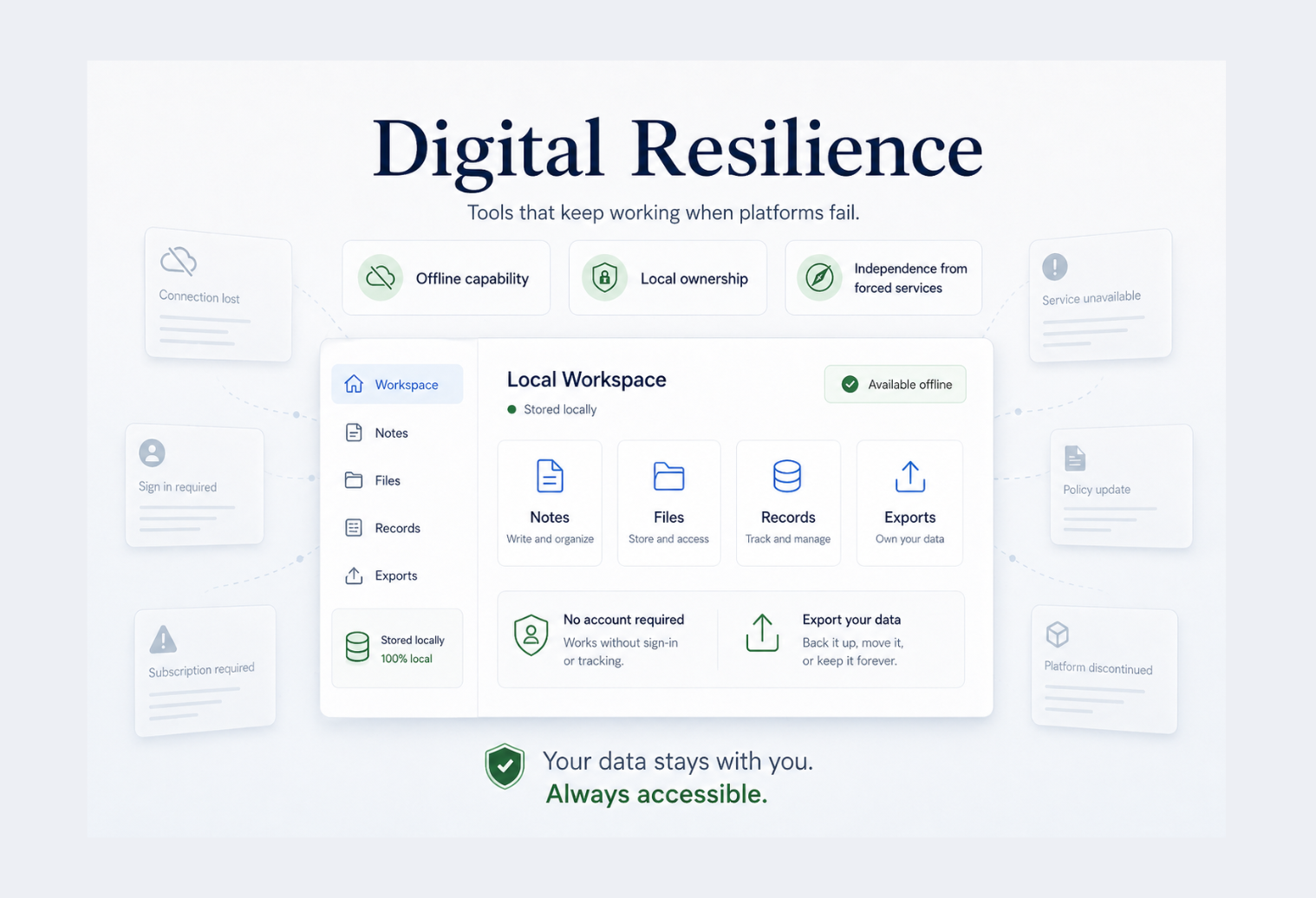
Why calm, offline-first software lasts when everything else breaks
Most modern apps are built on fragile foundations.
They depend on accounts, subscriptions, servers, policies, and platforms you don’t control. When any one of those changes — your access, your data, or the entire app can disappear overnight.
Digital resilience is a different approach.
It’s about software that keeps working even when services shut down, companies pivot, or platforms change the rules. It’s about tools designed to last — quietly, reliably, and without constant dependence on the cloud.
What Digital Resilience Really Means
What Does Digital Resilience Look Like?
At its core, digital resilience is built on three principles:
- Offline capability
- Local ownership
- Independence from forced services
When software meets these, it becomes calm — not fragile.
Digital resilience isn’t about rejecting technology.
It’s about choosing tools that respect long-term reliability, ownership, and independence.
Resilient software:
- Works without permanent internet access
- Doesn’t require accounts to function
- Stores data locally, under your control
- Avoids forced subscriptions and lock-ins
- Continues working even if a company disappears
When software is built this way, it becomes calm. Predictable. Durable.
And most importantly — yours.

“Your access shouldn’t disappear just because a platform changes its rules.”
Why Most Apps Are Fragile by Design
Cloud-first apps optimise for growth, analytics, and recurring revenue — not longevity.
That often means:
- Mandatory accounts
- Server-dependent features
- Subscription access models
- Remote data storage
- Forced updates and policy changes
When any part of that stack fails, users lose access.
Digital resilience avoids this by design — not through promises, but through architecture.

Offline-First Is the Foundation
Offline-first design is the core of digital resilience.
When an app works fully offline, it doesn’t depend on constant connectivity, authentication servers, or background syncing. Your data remains accessible regardless of outages, account issues, or service shutdowns.
This is why offline-first software isn’t a feature — it’s a philosophy.
If you want a deeper explanation of why offline-first matters, you can read it here:
“Resilience isn’t a feature — it’s the difference between tools that last and tools that vanish.”
Tools Built to Last
ZeroCloudApps exists to turn these principles into real tools.
Every app we build follows the same rules:
- No required accounts
- No cloud dependence by default
- No behavioural tracking
- No forced subscriptions
- Data stays on your device
These are not platforms.
They are tools.
Designed to work quietly, reliably, and independently — for years.
The Digital Ownership Manifesto
We believe software should serve people — not platforms.
We believe your data should belong to you, not be rented back through subscriptions, accounts, or recurring access fees.
We believe tools should keep working even if a company pivots, shuts down, changes ownership, or updates its policies.
We believe calm software is better than addictive software.
We believe privacy should be the default — not a premium feature.
We believe offline capability is a sign of respect, not a limitation.
We believe durability matters more than growth hacks, analytics dashboards, or engagement metrics.
We design software to work without permanent internet access, mandatory accounts, or constant server dependency. Your data stays on your device, under your control.
Some ZeroCloudApps include optional AI features that can be enabled using your own API keys.
These features are never required for core functionality.
Your data is not sent anywhere unless you explicitly choose to use an external service.
You remain in control of when, how, and whether AI is involved.
Offline-first remains the default.
External services are opt-in, transparent, and user-controlled.
We build tools, not platforms.
We avoid lock-ins, trackers, and hidden dependencies.
We design for longevity, clarity, and independence.
If you value ownership, resilience, and simplicity —
you’re in the right place.
Frequently Asked Questions
Q: What does offline-first really mean?
It means the app functions fully without cloud access or accounts — your data stays with you.
Q: Are these apps safe?
Yes — no accounts, no tracking, and data stays local unless you choose otherwise.
Q: What about optional AI features?
AI is always opt-in via your own API keys and never required for core functionality.
Q: Can you still sync data?
Offline-first doesn’t block sync — it lets you control if and how you choose to sync.
Part of a Global Privacy Shift
Around the world, people are questioning always-online platforms, centralized data storage, and surveillance-based business models. A growing movement is pushing technology back toward user ownership, local-first design, and digital minimalism.
ZeroCloud Apps is part of that shift — applying these principles to everyday tools like journaling, planning, health tracking, and documentation.
Digital resilience isn’t a trend — it’s a commitment to tools that respect your control, privacy, and independence. When software works for you, not against you, your data and your life stay yours.
ZeroCloud Apps is independent, self-funded, and built with long-term sustainability in mind.
Our apps are free to download and use. If you find them valuable, you can choose to support ongoing development through voluntary donations — never subscriptions, never data monetization.
Support ZeroCloud Apps
ZeroCloud Apps is an independent project focused on building offline-first, privacy-respecting software — without ads, trackers, or data monetisation.
Support the projectThank you for supporting independent, offline-first software ❤️
ZeroCloud Apps is an independent software brand operated by Neural Muse Lab (ABN 55260873316), based in Sydney, Australia.
We focus on creating privacy-first, offline productivity tools and evidence-logging apps for individuals and small teams.
For business inquiries, please contact:
✉️ hello@zerocloudapps.com