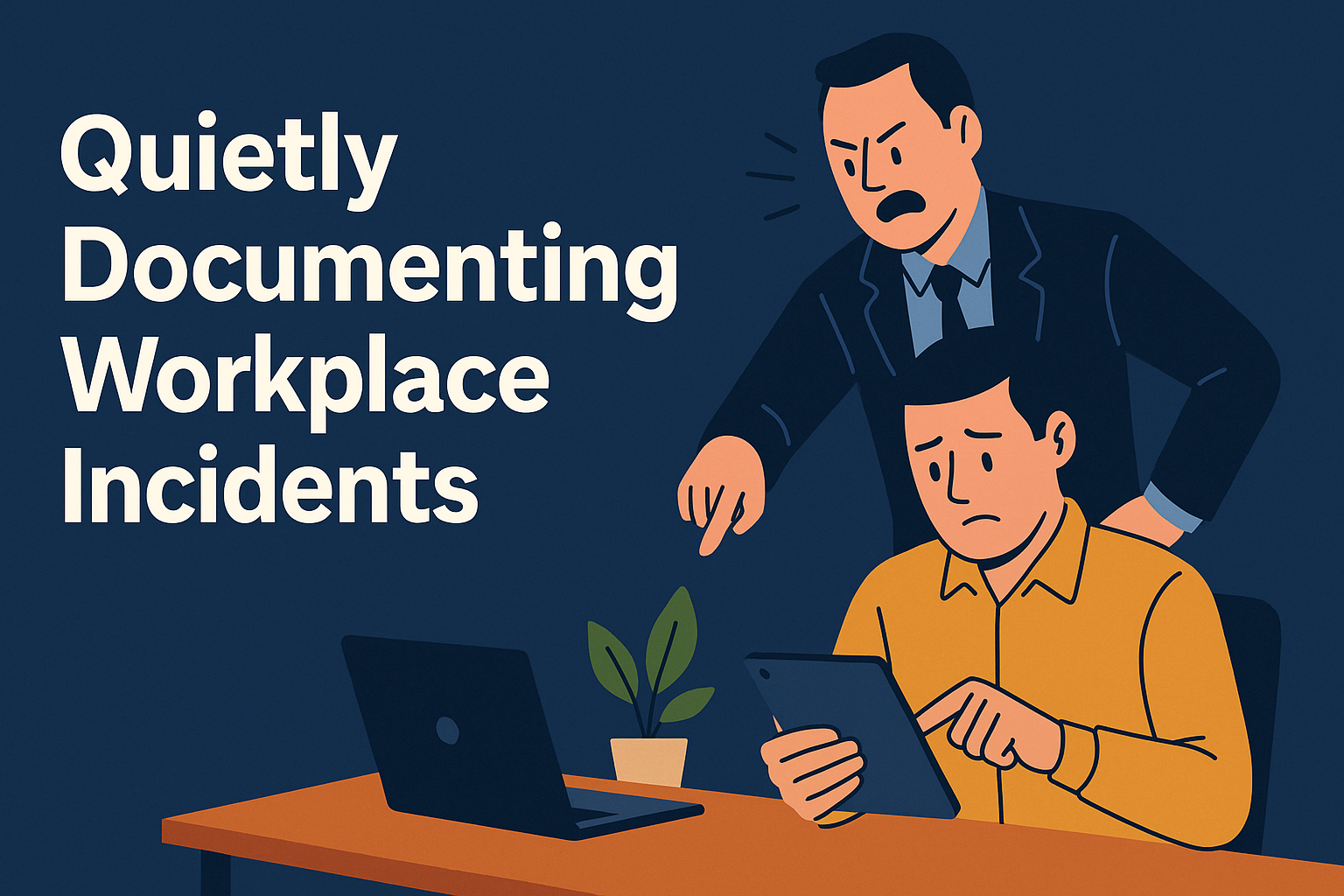
Facing bullying or wage theft at work can leave you feeling powerless. One empowering step is to quietly document every incident – but you must do it safely, without tipping off your employer or leaving a digital trail. In toxic or exploitative workplaces, a private “paper trail” can be your best defense. This guide will walk you through why stealthy documentation matters, how to keep records offline and secure, what details make an evidence log strong, and how to use your log in future HR, legal, or union actions. The tone here is empathetic and practical – you’re not alone, and you deserve to protect yourself.
Illustration: An employee privately discussing documented incidents with an HR representative. Maintaining a personal record empowers you to speak up with confidence when the time comes.
Why Stealthy Documentation Matters
Documentation is power. Harassment, bullying, or chronic underpayment often boil down to “your word against theirs.” By keeping a detailed record, you turn subjective experiences into concrete evidence. Accurate logs establish patterns of behavior (or underpayment) and substantiate your claims, making it far more likely that HR or authorities will take action. In legal or formal investigations, the person with the clearest timeline and supporting facts often has the strongest voice. In one real scenario, a manager’s attempt to fire a workplace bully failed because he had only scant notes; HR warned there wasn’t enough evidence to justify termination. Don’t let lack of proof be the reason nothing changes.
Why “quietly” document? Sadly, not every company welcomes complaints – some perpetrators might retaliate if they know you’re logging their behavior. Keeping your documentation discreet and offline protects you from tipping off a bully or unscrupulous boss. It also prevents the employer from monitoring or sabotaging your evidence. By recording incidents privately, you gain a sense of control in an uncertain situation without immediately escalating the conflict. This lets you decide if and when to report, armed with a credible case file when you do.
The Hidden Risks of Digital Trails
It may be tempting to jot everything down in a convenient cloud app or on your work computer – don’t do it. Using employer-provided tools or cloud services can backfire for several reasons:
- Employer Access: Most companies have policies stating employees have no expectation of privacy on work devices or accounts. If you save notes on a company computer or server, your employer can legally access or monitor those files. Never keep personal incident logs on a company computer or in shared work folders. Likewise, avoid work email or work Google Docs for documenting sensitive issues. One HR tip is clear: “Avoid using shared devices or accounts connected to your workplace” when compiling evidence.
- Digital Footprints: Standard cloud apps (Google Docs, Office 365, etc.) sync your data to servers you don’t control. Even if you use a personal account, anything stored online could potentially be accessed by others – whether through hacking, subpoenas in a legal dispute, or mistakenly through linked accounts. Your private notes might reside on servers subject to employer surveillance or data breaches. As privacy experts warn, your data on the cloud lives on someone else’s server, which means you relinquish some control.
- Accidental Discovery: If you’re logged into a cloud app at work, IT staff might see network traffic or open documents. If you leave a document open or printed, a nosy coworker could stumble on it. Even autosave features can leave fragments of your notes in places you don’t expect. To be safe, keep your documentation off the cloud and off workplace networks. This dramatically lowers the chance of prying eyes on your evidence.
- Employer-Owned Apps: Be cautious with any tool provided by your employer (e.g. internal incident reporting systems or note-taking apps tied to your work login). Assume that anything on company platforms can be seen by the company. The goal is to retain uninterrupted access to your records without fear of deletion or discovery by others at work.
Bottom line: Use personal and offline methods to document incidents. By minimizing your digital trail, you stay under the radar until you’re ready to act.
Building a Strong Evidence Log: What to Record

Once you’ve set up a safe way to record information, focus on what details will make your log credible and useful. Strong evidence logs share some key elements that HR professionals, lawyers, and investigators look for:
- Dates and Times: Always note when each incident happened. A chronological timeline is crucial. If you write things down as soon as possible after they occur (ideally the same day), your notes will be viewed as more reliable. Contemporaneous notes (records made shortly after an incident) carry weight because they show you weren’t inventing stories later.
- Locations and Context: Record where it happened (e.g. “June 3, 2025, 2:15 PM – staff meeting in conference room” or “On a job site, during lunch break”). Context helps others understand the environment. Note if it was in person, on a Zoom call, via email, etc.
- Names of People Involved: List exactly who was present. That includes the person who bullied or made the unfair decision, and any witnesses. For example: “Present: Myself, John Doe (supervisor), and two team members (Alice and Bob).” Having names means investigators can follow up with others later. If it’s a group situation or meeting, identify everyone in the room or on the email thread.
- The Exact Behavior or Quote: Be specific and objective in describing what happened. Stick to the facts and actual words or actions, not your interpretations. Instead of writing “My boss was being a jerk“, write “Supervisor said, ‘If you don’t like it here, you can leave – plenty of people want your job,’ in front of the team.” Direct quotes and concrete actions (yelling, slamming a door, giving an impossible deadline) speak louder than labels like “rude” or “unfair”. By documenting the exact language or behavior, you remove ambiguity. If it’s about underpayment, record the facts: e.g. “Worked 9 hours but was paid for 8” or “Promised a raise in writing, which never came.”
- Impact on You or Work: Describe any immediate effects the incident had on you or your job performance. Did the bullying remark leave you shaken, unable to finish your work that day? Did the underpayment force you to skip bills or work overtime later to catch up? Note things like “I felt humiliated and had to step away to regroup,” or “This caused a project delay because I spent time resolving the issue.” Documenting impact not only bolsters a harassment case (by showing a hostile environment) but also supports claims for damages (e.g. stress, lost wages) if it ever becomes a legal matter. Keep it factual: “After the meeting, I experienced a panic attack and needed to use sick leave” is a factual impact statement.
- Your Response (if any): Briefly note how you responded at the time. Did you say anything in return or report it to someone? For example, “I told him that comment was inappropriate” or “I immediately emailed HR about this”. If you chose not to react openly, that’s fine – you can note “Did not respond in the moment due to fear of retaliation.” Recording your reactions (or intentional non-reaction) shows how you’ve attempted to handle the situation.

- Any Evidence or Documentation: If there is tangible evidence associated with the incident, log it and keep a copy. For instance, if the bullying took place over email or chat, save those messages. If it was a verbal incident, and you wrote it in your journal, that journal is evidence – but also note if a colleague witnessed it. For underpayment issues, keep relevant pay stubs, timesheets, or bank statements. You might write, “Attached: photo of the schedule showing my shift, and pay stub for that pay period missing those hours.” By cross-referencing your notes with supporting documents, you create a stronger case. (More on preserving evidence in the next section.)
- Pattern Tracking: Over time, your log should reveal patterns. Make it easy to see if the same person is repeating behavior or if wage discrepancies recur. You can tag entries or simply note, “(Third time this month)”. This will help later to show frequency – e.g. “Supervisor insulted me in meetings 5 times between March and May.” Patterns are powerful in proving that issues are not one-off accidents but part of a larger problem.
- Honesty and Complete Story: Finally, be truthful and objective. Don’t omit key details even if they might not paint you as perfect – for example, if you also raised your voice in one confrontation, include that. Showing the whole story enhances your credibility. A factual, first-person chronological account that an outside reader can follow will be taken seriously. Pretend you are writing a report for someone who has zero context; include enough detail that it “makes sense” on its own.
Your entries don’t need to be long. In fact, concise, clear notes are often best – a few sentences capturing the above points for each incident is enough. The key is capturing the right information consistently.
Staying Private and Offline: Safe Ways to Log Incidents
We’ve stressed not leaving a cloud trail – but how exactly do you safely maintain your log? Here are some methods and best practices to keep your documentation private, offline, and secure:
- Use a Personal Notebook or Journal: The simplest old-school method is often the safest. A paper notebook (kept at home, not at your desk) is 100% offline. Write entries by hand and date them. You might even periodically photocopy or scan pages and keep them in a safe place, so you have a backup. If you worry about others finding the notebook, keep it in a locked drawer or a bag you always carry. The downside is you’ll need to organize and possibly type up notes later for sharing, but the upside is absolute privacy. No digital trail exists unless you create one.
- Personal Devices Only: If you prefer digital, use your own personal phone or computer, not any device managed by work. Consider using a spare laptop or a USB drive that stays with you. If you’re documenting on your phone, secure it with a strong passcode or biometric lock. Avoid syncing your notes to cloud services – for example, you can use a notes app that allows local storage only, or disable cloud backup for that particular file/app. Also be mindful of any employer “mobile device management” on your phone (if your company has installed software on your personal phone for email, assume they might access some data). It might even be worth using a completely separate device for sensitive notes if you’re in a high-surveillance environment.
- Password-Protect and Encrypt: If you keep files on a computer, protect them. You can use basic tools like a password-protected Word document or an encrypted ZIP file to store evidence. Better yet, use dedicated encryption software or enable full-disk encryption on your device (most phones and computers have this by default now). That way, even if someone gets a hold of your device, they can’t easily read your private log without the password. Make your passwords strong and do not share them.

- Dedicated Offline Apps: There are apps specifically designed for offline, private journaling and incident logging. These can add convenience and security. For example, QuietEvidence is an app built for documenting workplace incidents fully offline. It requires no account or cloud login, and it never uploads your data – “no accounts, no cloud, no tracking — your evidence stays yours”. All entries stay encrypted on your device, and you can attach photos or screenshots, with timestamps, and later export a PDF report if you need to share evidence. Because nothing ever syncs to a server, you’re not exposing any data to your employer or third parties. QuietEvidence is one example; there may be others with similar offline, encryption-first approaches. If you use an app, double-check that it works without internet and doesn’t automatically store your files in a cloud drive. The best tools will explicitly say they keep data local (look for phrases like “100% offline” or “stores data on your device only”). Using a dedicated app can simplify organizing incidents and ensure time-stamped, tamper-resistant records (some apps even use independent timestamping to prove when you wrote an entry). Just remember to still secure your device with a passcode and keep the app icon or content out of sight from prying eyes.
- External Storage Backups: If you’re going fully offline, one risk is losing your only copy (a stolen phone, a house fire destroying a notebook, etc.). To mitigate this without the cloud, you can occasionally back up your records to a safe medium. For physical notes, you could photocopy or scan pages and keep them in a sealed envelope with a trusted friend or relative, or in a safe deposit box. For digital notes, consider saving an encrypted copy to a USB flash drive or an external hard drive that you keep at home (or again with someone you trust). Another offline backup method: export your digital log to a PDF and print it out periodically – paper can’t be hacked. If you do use a cloud drive or email to store a backup, encrypt it (e.g. use a password-protected zip file) so even if that account was accessed, the content remains locked. In any case, do not use your work accounts or devices for backups – use a personal email on a personal device at minimum, or stick to offline backups.
- Be Mindful of Metadata: If you are creating Word docs or PDFs, be aware that those files sometimes contain metadata (like authorship, timestamps, or even previous edits). This is generally fine – timestamps can actually help prove when you wrote something – but if you don’t want your name or company computer name showing up as the “author” of a document, take steps to clean the metadata. You can usually find an option in the document properties to remove personal information, or export to a plain text format.
- Keep It Discreet: Whatever method you choose, keep it low-profile. Don’t mention to coworkers that you’re “keeping a file” on someone. Don’t leave a notebook out on your desk. When documenting at work (say, jotting a quick note in your phone after a meeting), do so privately. If you need to excuse yourself (“I’m stepping out to take notes on this”), you might raise suspicion – instead, try to write things down during breaks or right after work. Some people find it useful to send themselves a quick personal text or voice memo in the moment (to capture quotes or time), and later transfer it to the main log in detail. If you do this, use a secure messaging app like Signal to message yourself (Signal messages are end-to-end encrypted, providing a measure of privacy even in transit). But treat that as a temporary measure and move it offline soon.
By following these practices, you can maintain a thorough record without alerting your employer or risking that your evidence disappears. You’ll be prepared when it’s time to act, and until then your documentation remains your eyes-only secret.
Best Practices for Effective Incident Logging
Beyond what to record, it’s important to consider how you write your entries and manage your log over time. These best practices, informed by HR experts and employment lawyers, will ensure your documentation holds up under scrutiny:
- Log Incidents Promptly and Consistently: Don’t wait weeks to write things down. Record each incident as soon as you safely can – ideally the same day. Memories fade and details blur, and writing promptly adds credibility (it’s contemporaneous). Make it a habit: if something happens, commit to documenting it by the end of the day. Consistency matters too. A log that’s updated regularly (even with “nothing new happened this week” notes) looks more credible than sporadic entries. It shows you were diligent and serious about the issue over time, not just scribbling things right before a complaint.
- Stick to Facts, Not Feelings or Theories: We touched on this, but it’s crucial: keep your tone professional and objective. Imagine your log being read aloud in a courtroom or HR meeting. Does it sound like a factual account, or an emotional rant? Use factual, neutral language – you’re essentially writing evidence, not a diary to vent in. Avoid inflammatory words or insults, even if you’re angry. For example, don’t write “My boss is a sociopath who’s trying to destroy me.” That may be how you feel, but it undermines your credibility. Instead, record observable behaviors: “My boss assigned me five projects due within impossible timelines and then publicly criticized me for not finishing”. Let the facts speak for themselves. Also refrain from guessing motives: “I think he did that because he hates women” – unless you have direct evidence of a discriminatory remark, stick to “He did X, Y, Z which created X effect.” By staying factual, you present yourself as a calm, rational reporter of events – exactly how you want to appear to HR or a judge.
- Be Detailed but Concise: Include all the key details we listed (who, when, what, etc.), but don’t write a novel for each incident. Long-winded entries can obscure the important facts. If you need to, use bullet points or a structured format for each log entry. For example: Date: Nov 5, 2025
Who: Me and [Supervisor] in weekly 1:1 meeting (Teams call)
What happened: Supervisor said “Maybe if you worked harder, you’d earn more. I can always find someone cheaper.” This was said after I asked about my overdue raise. Tone was sarcastic and loud.
Impact: I felt demeaned and it’s clear my pay raise is being withheld unfairly. (I have the chat log showing he agreed to a raise by July – see attachment.)
Follow-up: I told him that comment was inappropriate. He rolled his eyes and ended the meeting. I saved the chat transcript and took notes right after the call. A structured format ensures you hit every important point. It’s also easier to scan later for patterns or to pull out key quotes.
- Secure and Back Up Your Log: Treat your evidence log like a sensitive document. Protect it from loss or snooping as described in the prior section. This is a best practice worth repeating: don’t keep it on work systems, do keep a backup, and consider encryption for digital files. You might even periodically email a copy of your log to your personal email (not work email!) just to have a timestamped backup in your inbox – but only do this if you’re sure that email isn’t accessible to your employer. Alternatively, some people mail a physical copy of their notes to themselves (to get a postmark date) and then don’t open the envelope. This can serve as a kind of timestamp if ever needed to prove when you wrote it. Use such tactics cautiously and always prioritize keeping the content itself hidden from unintended readers.
- Capture Supporting Evidence: Augment your written log with auxiliary evidence whenever possible. If an incident involves an email, save the email (in a secure location). If it’s a verbal incident, and you can safely do so, you might record audio (check legality – recording someone without consent is illegal in some jurisdictions unless it’s to gather evidence of a crime; when in doubt, stick to written notes). For bullying, save things like screenshots of nasty messages or photos of any physical evidence (e.g., a defamatory note left on your desk). For underpayment, keep meticulous records of hours worked versus hours paid: use a notebook or spreadsheet to log your work hours, breaks, and overtime. Save pay stubs, bank deposit records, and paycheck copies to compare what you received vs. what you’re owed. Keep copies of any communications about pay – for example, texts or emails where you asked about missing wages and your boss’s responses (take screenshots of those texts). Having these pieces of evidence attached to or referenced in your log makes it much harder for someone to dismiss your claims. It’s one thing to say “I think I’m underpaid by about 5 hours on my last check” versus “On June 1–7 I worked 45 hours (see attached timesheet and coworkers’ corroboration) but was paid for 40 (see pay stub)”. The latter is undeniable. Organize these files in parallel to your written log – e.g. keep a folder of evidence labeled by date or topic. In your log, you can note “[see File: JuneTimesheet.png]” so you know what backs up that entry.
- Keep it Confidential (Until Needed): It bears repeating: do not share your documentation casually. You might feel tempted to show a sympathetic coworker or to confront the bully with “I’ve been writing this all down.” Resist that urge. Your log is for your eyes (and eventually HR or legal) only until you decide to take action. Prematurely revealing it could lead to document tampering (a toxic boss might try to preemptively cover their tracks or retaliate) or interpersonal drama at work. Maintain your advantage by keeping your evidence under wraps.
- Mind Your Emotions While Writing: It’s natural to be upset when describing a humiliating or infuriating incident. However, try to write when you are relatively calm. If you’re extremely emotional, you might scribble things that are less coherent or too inflammatory. Take a few deep breaths, or wait an hour after the incident if needed, so you can approach the entry with a cooler head. This ensures clarity. One psychological tip: think of yourself as a reporter or scientist documenting what happened. This slight emotional detachment can help you stick to facts. If you need to vent feelings, do so in a separate journal or to a trusted friend – keep your evidence log itself professional. Remember, staying calm and professional in your documentation shows you’re focused on resolving the issue constructively. It can actually strengthen your case, because it demonstrates you are not acting out of hysteria or impulsiveness, but out of genuine concern and reason.
By following these best practices, you’ll develop a log that is credible, precise, and powerful. Anyone reviewing it – be it HR, an attorney, or a union rep – will quickly grasp what happened and why it’s a serious issue.
Looking After Yourself While Documenting

Dealing with workplace bullying or underpayment is stressful and emotionally draining. As you document incidents, it’s important to care for your mental well-being. Here are some compassionate pointers to help you stay clear-headed and resilient through the process:
- Separate Facts from Feelings: As mentioned, maintain an objective tone in the log – but that doesn’t mean you should ignore your feelings entirely. Acknowledge to yourself that what’s happening is not okay and that your feelings (be it anger, fear, or sadness) are valid. Some people keep a private personal diary in addition to the factual log, to process emotions separately. This can be therapeutic. Just ensure that emotional diary is also kept private.
- Use the Act of Writing to Regain Control: Psychologists often note that writing about trauma or stress can be empowering. When you document an incident, you are actively taking control of the narrative. You’re no longer a silent victim; you’re an observer gathering proof. Remind yourself of that. One law firm puts it: creating a written record “gives you a sense of control in an otherwise uncertain situation”. Instead of replaying the incident in your head, you’ve pinned it down on paper – it’s there, and you can move on until the next step. This can reduce the rumination and help you feel a bit more in charge.
- Stay Calm and Grounded During Incidents: When bullying or unfair treatment happens, your immediate reaction might be emotional. If you can, use simple techniques to stay calm in the moment, since you know you’ll be writing it down later. Take slow breaths, maintain a professional demeanor, and remind yourself internally, “I will document this later. I don’t need to react right now.” If the situation is overwhelming, it’s okay to politely excuse yourself (e.g., “I need to step away for a moment”) and find a private spot to breathe and jot down notes. Do not retaliate in anger – an outburst from you could muddy the waters or even lead to disciplinary action against you. Keeping your cool is not just good for your mental health, it also helps your case; you don’t want the bully or management to claim your behavior was the issue. Your log will show that you remained professional, which contrasts with the bully’s behavior.
- Don’t Blame Yourself: Bullying and wage exploitation can erode your self-esteem. You might start to doubt yourself (“Maybe I’m overreacting? Maybe I deserve this?”). This is when your documentation can actually help affirm reality. Looking at a pattern of events in your own words can validate that, no, you’re not imagining things – there is a documented problem. Your experience is real and important. As one resource put it, documentation validates your experience, even if you never report. So treat yourself with the same fairness you’d treat a friend: the blame lies with the bully or the unfair employer, not you. Use your notes as a reminder: “This happened, it was wrong, and I have a right to feel upset.”
- Reach Out for Support (Safely): Keeping documentation “quiet” doesn’t mean you must endure the situation in silence emotionally. Consider confiding in a trustworthy person outside of work – this could be a spouse, a close friend, a therapist, or even an anonymous support hotline. Talking about it can relieve stress and help you stay sane. Just be careful not to discuss it with anyone who might accidentally tip off someone at work. If you have a mentor or former colleague you trust, they might offer perspective or advice without endangering your confidentiality. Sometimes just having someone say “That’s not okay” reinforces that you’re justified in taking these notes and eventually taking action.
- Practice Self-Care: Logging incidents can be triggering; you’re recounting negative experiences in detail. Make sure to decompress afterwards. Engage in activities that calm you – exercise, meditation, journaling (about personal feelings, separate from the work log), or hobbies that take your mind off work. Ensure you’re getting enough rest. High stress can cloud your memory and judgment, so self-care isn’t a luxury, it’s part of maintaining your ability to document clearly and deal with the situation. If the workplace stress is harming your mental or physical health seriously, consider speaking with a mental health professional. In some cases, your documentation could also extend to tracking symptoms (like anxiety or doctor visits) if you later need to show the personal toll the workplace situation caused. But first and foremost, take care of you.
- Know Your Allies: If you are part of a union or employee association, you typically have the right to seek their support. Many unions have seen cases of bullying or wage theft and can guide you. You can often talk to a union representative confidentially about what’s happening. They might advise on how to document or even suggest what kind of evidence would strengthen a potential grievance. Unions also sometimes keep things off-record until you’re ready to file formally. Utilizing these resources can give you moral support and practical tips, which reduces the isolation you might feel.
- Stay Hopeful: It’s easy to feel like nothing will ever change, especially if the workplace culture is toxic. But numerous employees have turned the tables by methodically gathering evidence and then using it at the right time. There have been cases where detailed logs of harassment or unpaid wages led to successful HR interventions, settlements, or court verdicts in favor of the employee. For instance, employees have won wage-theft claims in court by presenting meticulous records of hours worked versus pay received – something the employer could not refute. Harassment victims have reached favorable settlements when they could show a pattern of behavior backed by dates, quotes, and witness names. Change is possible, especially when you have the truth documented on your side. Remind yourself of this on tough days: you are quietly building a shield and a sword with your evidence. It can lead to justice, or at least an end to the mistreatment, down the line.
By keeping calm, seeking support appropriately, and recognizing the power of what you’re doing, you’ll not only create a strong log – you’ll also take care of your mental health during this challenging time. The goal is to emerge with both evidence and your well-being intact.
Using Your Documentation: From HR Reports to Legal Action
At some point, you may decide that simply keeping records is not enough and it’s time to act on the information you’ve gathered. Whether you approach your HR department, file a legal claim, or involve a union, your quiet documentation will become a critical tool. Here’s how to leverage your evidence log when the time comes:

- Approaching HR or Management: When you’re ready, request a meeting with a trustworthy HR representative or manager (ideally not the person implicated in your log!). During this meeting, you don’t necessarily want to dump everything on them at once – too much detail can overwhelm. Instead, come prepared with a summary of key points from your documentation. You might create a short, factual summary: e.g., “Over the last 3 months, my supervisor has made X inappropriate comments and withheld Y amount of pay, which I have documented with dates and examples.” Have your full log and evidence organized and on hand if they ask for specifics. HR may want copies of certain incidents or may ask you to write a formal complaint. You can use your documentation to swiftly fill out any official incident report forms with accurate information. Present your case calmly and clearly, referencing your notes to ensure accuracy. You might even say, “I’ve been keeping a detailed record to ensure I get this right,” which signals that your claims are not just spur-of-the-moment. After the meeting, write a follow-up email thanking them and reiterating the main points you reported (this creates a paper trail that you did report on such a date). Remember to keep copies of everything you submit.
- Involving Your Union: If you’re unionized, you might choose to go to your union before or instead of HR (especially if HR is unresponsive or the employer is the problem). Show your union steward or representative your documentation. They will likely be impressed – it makes their job easier in advocating for you. The union can file a grievance on your behalf, and your records will guide the specifics of that complaint. In union arbitration or grievance meetings with management, your documented timeline and evidence give the union concrete proof to argue your case. It moves the discussion from vague allegations to documented violations of policy or contract (e.g., harassment violates the respectful workplace policy, underpayment violates the wage provisions of the union contract). Work with the union on what to present; they might advise sharing some documents and holding others in reserve. Unions also provide support and can help protect you from retaliation as the process unfolds.
- Legal Avenues – Lawyers and Government Agencies: If the situation is severe or not resolved internally, you might consult an employment lawyer or contact a government labor agency or human rights commission (depending on the issue). Your documentation is the foundation of any legal case. When you meet a lawyer, you can provide them a copy of your log and relevant evidence. This saves the lawyer time and shows them you have a potentially strong case. In fact, attorneys often say that clients who come in with well-organized evidence are much more likely to succeed. Your lawyer can use your timeline to pinpoint legal violations (for example, each instance of harassment, each paycheck discrepancy) and to calculate damages (like how much unpaid wages you’re owed, or the toll of emotional distress). If you file a formal complaint with a government body (like an anti-discrimination commission or labor board), they will ask for details – dates, what happened, etc. You will have all of that ready to go in your log. This can accelerate investigations. If your case proceeds to a lawsuit or tribunal, your contemporaneous notes may even be admissible as evidence to support your testimony, since they were recorded in the moment. Lawyers can also call any witnesses you identified, using the info from your notes. Simply put, your quiet logging can tip the balance of proof in your favor. One guide on wage claims noted that without solid proof, it’s just your word versus theirs – but proper documentation strengthens your credibility, makes your case easier to prove, and increases your chances of winning in court. The same holds true for harassment or bullying cases.
- Realistic Outcomes: Documentation doesn’t guarantee a particular outcome, but it dramatically improves the odds of a favorable one. In the best-case scenario, HR might take swift action: the bully could be disciplined or required to undergo training; wage underpayments might be corrected with back pay once you present the evidence. Sometimes, the very act of presenting evidence prompts a settlement or resolution – for example, an employer might offer you a settlement to leave quietly if you have proof of serious wrongdoing, or they might quickly pay owed wages to avoid further trouble. If you pursue legal action, strong evidence can lead to winning a case or securing a meaningful settlement. Even if the outcome is just that the behavior stops or you find a better job and move on, you’ll know that you did everything in your power to document the truth, which can be important for personal closure.

- Keep Documenting Throughout: If you do report internally or file a complaint, continue to document what happens next. Note any retaliatory behavior (retaliation is often illegal, and you should record if, say, suddenly you get written up or cut from schedules after reporting – that can be a separate violation). Also document any interactions related to your report: dates of meetings, who said what, any promises made by HR (“we will investigate by X date”), and so on. If they don’t follow through, your notes on their inaction could be useful if you escalate the matter. Basically, the documentation doesn’t stop when you file a report; it evolves to cover the handling of that report as well.
- Know When to Keep Things Private: If your issue turns into a legal case, your lawyer might advise you on what not to share. For instance, you generally wouldn’t hand over your entire private journal to HR if you’re headed to court – you’d provide relevant extracts or incidents as needed. Be cautious about giving away your only copy; provide copies of evidence, not originals. During legal discovery, you may eventually have to turn over notes, but by then you’ll be guided by legal counsel. Until then, share what is necessary to achieve your immediate goal (stop the behavior, get paid, etc.), but you don’t need to volunteer every detail all at once.
- International Considerations: Workplace laws vary by country, but documentation is universally powerful. In some jurisdictions, bullying (if not tied to discrimination) might not be directly illegal, yet documented incidents can still support claims of constructive dismissal or breaches of health & safety laws. Underpayment might be handled by labor inspectors or courts – either way, logs and records of hours are key. If you ever deal with cross-border situations or companies in different countries, maintain records of where events happened as well. International or not, the core approach remains: clear evidence opens doors to enforcement of whatever laws or policies protect you. If unsure, seek local advice (many countries have worker advocacy groups or government hotlines where you can anonymously ask how best to proceed).

Using your documentation might feel daunting, but remember why you created it – to protect yourself and assert your rights. Whether you quietly hand over a dossier to an investigator or confidently quote dates and facts in an HR meeting, you’re transforming a bad situation into an opportunity for accountability. That’s powerful.
Conclusion: Documenting Today for a Better Tomorrow
You didn’t choose to be bullied or underpaid, but you can choose how to respond. By quietly documenting what’s happening, you’re taking back some power. You’re creating a record that cannot be easily dismissed or swept under the rug. This process requires courage, consistency, and care – but it pays off by empowering you and safeguarding your story.
Now is the time to start your own private evidence log. Every journey begins with a first entry: perhaps something happened today that didn’t sit right – write it down with the date and details. If nothing happened today, recall the last incident and document that. Set up whatever system works for you, be it a locked journal, an encrypted file on a USB stick, or a dedicated app like QuietEvidence that keeps your records offline and in your control. The key is to begin. Don’t wait for the “next time” – start now, so if/when it does happen again, you’re ready.
As you document, keep in mind the tips you’ve learned here: stay factual and timely, guard your privacy, and take care of yourself along the way. You are not “making a fuss” or “being disloyal” by doing this – you are looking out for your own well-being and rights, which is absolutely justified. Many others have been in your shoes and found that a solid paper trail was the turning point toward justice or resolution.
Your call to action: Take that notebook out or open that secure app, and make your first entry. Commit to logging the next incident that happens. By doing so, you’re investing in a safer, fairer future for yourself. Whether it leads to a successful HR intervention, a legal victory, or simply peace of mind knowing you stood up for yourself, you’ll be glad you took this step.
Remember, you deserve a workplace where you are treated with respect and paid what you’re owed. If your current job isn’t providing that, your documentation is your safety net and your sword. Quietly keep recording, and when you’re ready, you can use your evidence to speak loudly. Your story, your safety, and your peace of mind matter – start protecting them today with a confidential incident log.
Empower yourself by documenting the truth, and stay safe. 💚 You’re not alone, and you have the right to a respectful, fair workplace.

— End —
If you found this article useful, you can support ZeroCloud Apps — an independent, offline-first software project built without ads, trackers, or data monetisation.
Leave a Reply